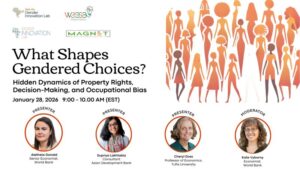
Three MAGNET researchers presented work on gender measurement at the virtual seminar "What Shapes Gendered Choices? Hidden Dynamics of Property Rights, Decision-Making, and Occupational Bias," co-hosted by the South Asia Gender Innovation Lab, the Africa Gender Innovation Lab, and the Women's Economic Empowerment in South Asia (WEESA) Community of Practice on January 28, 2026. Kate Vyborny (Economist, World Bank) moderated the session.
Aletheia Donald (Senior Economist, Africa Gender Innovation Lab, World Bank) presented Whose Job Is It? Implicit Gender Bias Toward Occupations in India and Uganda. Using a version of the Affect Misattribution Procedure (AMP) adapted for field settings, the study measured implicit bias toward gender-nonconforming occupational choices among women and men. The study found that 44% of respondents in India and 54% in Uganda exhibited bias toward gender-incongruent occupational roles, with the strongest effects for care work and manual labor occupations. Bias patterns varied across countries in ways consistent with local labor market characteristics. The findings validate a scalable tool for measuring implicit occupational bias in development contexts.
Supriya Lakhtakia (Consultant, Asian Development Bank) presented Who Keeps the Property? Evidence from Karnataka, India. The study uses vignettes administered to 838 couples across four districts in Karnataka to examine perceptions of how marital property would be divided upon permanent separation, varying the mode of acquisition—joint purchase, individual purchase, and inheritance. Perceptions of property rights are tied to how property is acquired, but asymmetrically: monetary contributions toward purchase are recognized, while wives' non-monetary contributions as homemakers are not equally valued by either men or women. When the husband is the sole purchaser or inheritor, respondents still perceive the wife would retain some share, but the reverse does not hold when the wife is the owner.
Cheryl Doss (Professor of Economics, Tufts University) presented Deciding Not to Decide: When Is There Power in Not Deciding?. Using mixed methods data from rural households in Kilifi County, Kenya, the paper distinguishes two forms of effective power when individuals are not directly involved in decision-making: effective power by proxy, where individuals opt out because they expect the outcome will align with their preferences, and effective power by influence, where individuals shape decisions indirectly. Men were more likely than women to hold effective power by proxy, particularly in decisions where social norms favor men's preferences by default. Across seven decision-making activities, men held some form of effective power in 22% of decisions where they were not a direct decision-maker, compared to 13% for women. Traditional decision-making measures may therefore underestimate the agency of individuals—particularly husbands and fathers—who rely on their preferences being met without bearing the cognitive cost of active engagement. But women, too, may have agency even when they are not directly making the decision.
 International Food Policy Research Institute