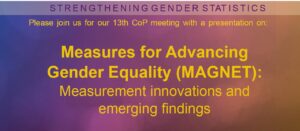
In two recent virtual engagements with national statistical offices (NSOs) and gender data practitioners, the Measures for Advancing Gender Equality (MAGNET) Initiative introduced innovative measurement tools designed to capture dimensions of women's agency that have traditionally been difficult to quantify in large-scale surveys and national statistical systems. On October 21, 2025, Aletheia Donald (Senior Economist, Africa Gender Innovation Lab, World Bank) presented an overview of the Measures for Advancing Gender Equality (MAGNET) Initiative during a virtual session of the Gender Data Network (GDN). On November 4, 2025, Maria Hernandez-de-Benito (Assistant Professor of Economics, CUNEF Universidad) delivered a closely aligned presentation for the Strengthening Gender Statistics (SGS) Community of Practice (CoP) meeting, broadening the reach of the same core measurement agenda.The sessions focused on six selected tools that represent practical approaches for capturing women's experiences, constraints, and choices across different contexts. The tools address key aspects of agency including ownership and control over assets, goal-setting and decision-making processes, and sense of control and efficacy. The MAGNET team shared illustrative findings from the validation work and discussed how these tools can be adapted to different data systems and contexts, from national household surveys to program monitoring.
The primary takeaway from the presentations was that as gender data practitioners increasingly seek to move beyond basic sex-disaggregated statistics to more nuanced measures of empowerment, the MAGNET tools provide tested, ready-to-use approaches for better capturing women's agency and informing policy and program design. The two presentations were opened by Meriem Ait Ouyahia (Gender Data Network Coordinator) and Alina Kalle (SGS project coordinator), respectively, and each was followed by an interactive Q&A discussion with participants exploring opportunities for collaboration and application of the tools.
 International Food Policy Research Institute